
Time: Cline & Stamper
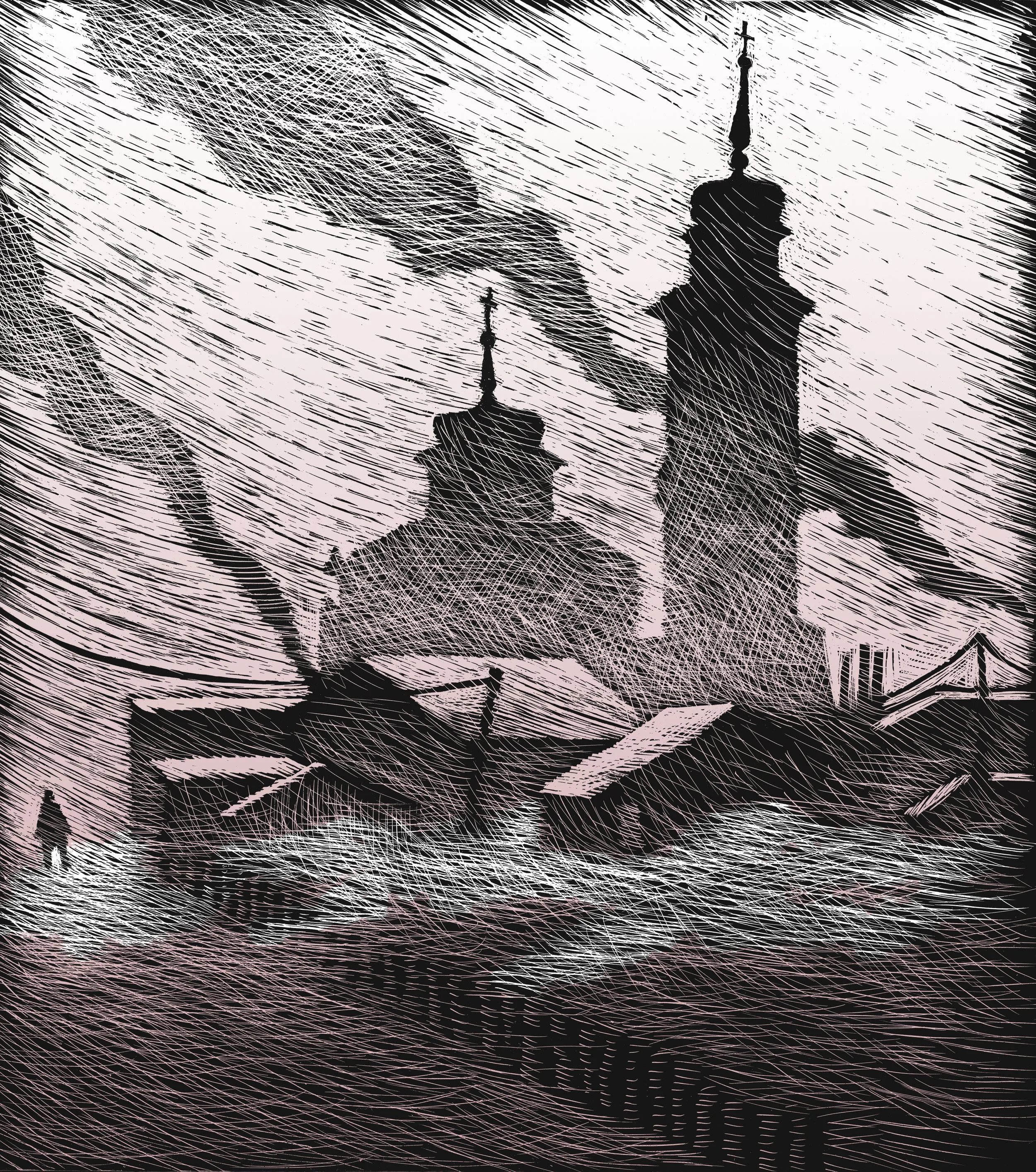
Toxic Village by Rocco Lombardi
TIME
The Crossing
Donald Nally, conductor
October 25, 2026
The Presbyterian Church of Chestnut Hill, Philadelphia
Program
The Sea Came Up and Drowned (2025) – Nicholas Cline
— East Coast premiere —
Part I.
There Was a Continuous Surface
That Goes a Long Way Toward Explaining
Across Deposits and Badlands
Gold Grave
Power Control
This Most Emphatic Collision
Part II.
The Endless, Unbegun
Floating About on a Liquid Interior
To See This Paradox
Remember Our Confusion Will Reach New Heights of Sophistication
‘mid the steep sky’s commotion (2017, rev. 2026) – Joshua Stamper
Prelude
I. drapes a silent earth
Prelude
II. dead calm
Prelude
III. as
Prelude
IV . breath
Prelude
V . this bottle of silver silk and ages moving
Prelude
VI. fists
Notes + Texts
The Sea Came Up and Drowned
music by Nicholas Cline
poetry by Rachel Jamison Webster and John McPhee
A note from the composer:
The sea came up and drowned. A sentence with a missing object. An ending that has been lost. Or not yet come to pass. A foretelling. The same story, repeated.
The erasure poems in Rachel Jamison Webster’s book, The Sea Came Up & Drowned, were “mined,” each from a single page of John McPhee’s Annals of the Former World, a monumental work that chronicles the geologic history of North America from New Jersey to San Francisco. Like the earth it describes, Annals of the Former World tells a story of many layers, offering the reader one of many paths through it – a geology primer, an exploration of plate tectonics, a study of geologic time.
Likewise, Webster’s The Sea Came Up & Drowned offers the reader multiple paths through its poems. The words tumble across the page, asking the reader to fill in the gaps between fragmented deposits. From the histories of westward expansion, patterns emerge in the distillation of McPhee’s words - colonial exploitation, extractive economies, and the costs of human erasure and climate upheaval.
As a meditation on deep time, The Sea Came Up & Drowned points toward other ways of knowing. The final section offers both hope and caution as we approach possible conclusions to the question posed by the title. In our progress and missteps, “Remember, our confusion will reach new heights of sophistication. We lurch forward from error to discovery to error to discovery. The fossil record will tell what happened. If not, it didn’t happen.”
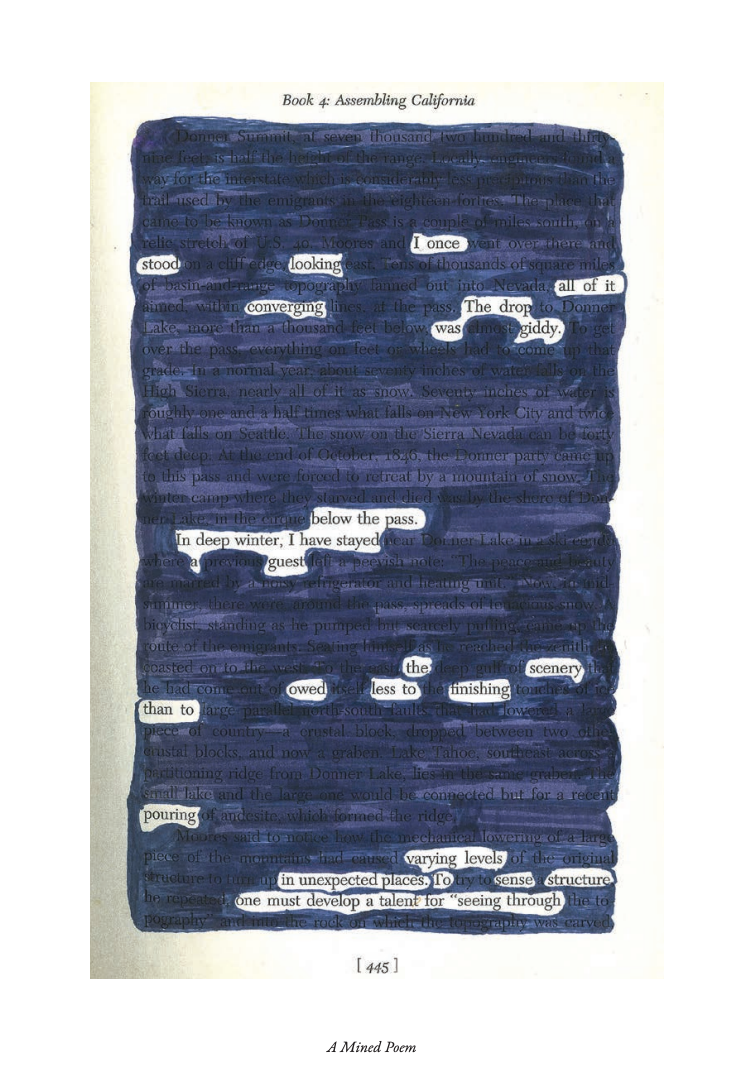
Poetry from The Sea Came Up & Drowned by Rachel Jamison Webster.
Permission granted by Rachel Jamison Webster.
Published by Raw Books Press, 2020.
Poems mined from Annals of the Former World by John McPhee.
Permission granted to Rachel Webster by John McPhee.
Published by Farrar, Straus and Giroux, 1998.
Part I.
There Was a Continuous Surface
I once stood looking
at all of it
converging.
The drop
The scenery
owes less to finishing
than to
pouring –
To sense structure
one must develop a talent for seeing through –
There was a continuous surface
not long ago.
Ten million years,
essentially the same
story, full of detail:
That Goes a Long Way Toward Explaining
Prospectors wore over their hearts
a magnet that
tingled and shocked. Prospectors
carried forked hazelwood rods,
baffled science, rendered
bone and
luck.
Geologists, scientific men,
unskilled men, soldiers, sailors –
nearly everybody would
catalogue the earth
for profit.
Being discovered had diminished to
being burned.
That goes a long way toward explaining
Such a large part of one
century.
Once oil has formed, it is subject to destruction
of its host.
They don’t know what
they’ve got until they drill a hole.
Across Deposits and Badlands
We are at
the mercy, Love said. It’s called colonization.
Scene after scene returning us to this theme:
Love is a
prospector who looks for wealth in exploitable rock.
Gold Grave
Mourners stake claims.
(So goes the story, dust into dust)
Miners come from every state and virtually
every county,
camp so deep in ravines
the light of the sun never reaches
the tents.
You live in a hole.
in the ground.
You sleep
beside your fire.
You wear a flannel shirt,
heavy leather boots.
You carry a pistol. Not everyone resembles you.
Power Control
Lined up in ranks,
the ironies far too large
to operate,
the
machine works
through gully and gulch, over hill and draw
traumatically compressing the dirt,
this strip mine,
where geologic time and human time
commingle
to join the present:
a site that
booms.
This Most Emphatic Collision
Like the boiling clouds or unfolding of a rose,
an
encounter so slow a word distorts its scale.
It buckled the
shelf, raising the sea
fifty thousand feet.
Part II.
The Endless, Unbegun
How it originated is the great
question.
As a young man,
he wrote
Species pass gradually from
one
to the other, appear and disappear
without relations.
All have a fixed time for coming
and going,
An invisible thread is unwinding itself through
the ages.
Floating About on a Liquid Interior
I am indebted to
the jigsaw fit,
the likeness. Its
infancy years away,
plowed like solid
basalt.
Almost no one believed.
To See This Paradox
What
appears to be but is not.
Streams flowing down
time, country and
what was left?
All this had happened. All this was represented.
The complete narrative less than apparent. The story
repeated through bands of
time,
remains disturbed:
a surface story, a latter-day account,
full of temporal gaps .
More time absent than represented.
Space between.
Remember Our Confusion Will Reach New Heights of Sophistication
We
Lurch forward from error to discovery
to error.
The departed are numerous.
The fossil record
will tell what
happened. If not, it didn’t happen.
‘mid the steep sky’s commotion
music and mesostics by Joshua Stamper
A note from the composer:
‘mid the steep sky’s commotion explores the enigmatic and unknowable character of wind, its singular and intimate relationship to the detritus of a city, and what this relationship suggests about time, transience, and language.
Each movement is comprised of words gathered, carried, and discarded by the wind: weathered gas receipts and church bulletins; scraps of conversation tangled in bushes; discarded newspapers, candy wrappers, concert flyers, and matchbooks decorating gutters and alleyways. It is a work of ‘lyrique concrète’, a found-text libretto culled from the streets of Philadelphia.
These ephemeral and disposable texts were then separated and recombined into mesostics, a poetic form pioneered by John Cage: similar to an acrostic, but with the vertical phrase intersecting the middle of each horizontal line (“meso” meaning ‘middle’). The rule is simple but strict: between any two letters of a y-axis meso-string (Cage also called them “spine words”), all x-axis words (or “wing-words”) containing the second meso-letter are disqualified from inclusion in the line. For example, between the ‘M’ and ‘E’ of the meso-string “HOME”, “match” is an eligible wing-word but “matches” is not: the ‘e’ is a disqualifier. The meso-strings become the principal scaffolding that each line of the libretto hangs on, acting as a sort of invisible helical DNA spiral—the central agent in binding words, separating words, creating order, disorder, generating motion.
Cage described the process of creating mesostics as “brushing” one text against another, an apt portrayal of the recombinatory activity of wind. commotion’s meso-strings were taken from the Hebrew and Christian scriptures, words and phrases concerning wind, word, or breath. My interest was in the relationship between texts that are fixed and texts that are fleeting. In performance, these vertical meso-strings are utterly indiscernible, but their governance of the lyric is absolute, just as wind is invisible save its effect on the world around it.
With the deployment of mesostic form, one poetic landscape is stacked on top of another, and movement is now possible across horizontal and vertical axes. The mesostic becomes a navigation device. Texts are brought into relation to orient, to restore scale, depth, breadth, and height.
* * *
The writing for me is more than academic curiosity or tinkering with different forms. It has emerged as a devotional practice, an honoring of what’s been discarded. The writing is necessarily very slow, but with slowness comes the opportunity to attend, to listen, to wait. In these moments, ‘lyrique concrète’ is experienced almost a devotional practe: the collection of words for their own sake, and the honoring of what’s been discarded.
In two of the six mesostics, the careful reader might discover a few occasions where I depart from the parameters described above. Despite my earnest attempts to remain to faithful to the constraints of mesostic form, the poems themselves exerted a greater authority. Isn’t this how it so often is? Whether one’s material is wood, clay, paint, fabric, or music, discipline ultimately must give way to what is emerging.
The wind blows where it pleases.
Which is to say, the commotion at the center of this piece is not just wind, but language. Language is a force to enliven, enchant, encourage, and enthrall, but it can also deceive, confuse and coerce. It is play, it is slander. Prayer and cursing. The joy and catastrophe of words runs through our literature, scripture, poetry, and myth: from Babel to Orpheus to Shakespeare to Joyce to Woolf.
In our own moment, language is a deluge: pundits, newsfeeds, shock-jocks, conspiracy think, TikTok, Firefox, Facebook, fact-check, late-night, free press, self-help, pings, pop-ups, billboards, spam, scams, influencers, email, snail-mail, junk mail, Sirius-XM, podcasts, podcasts, podcasts...
Amidst this unrelenting torrent of talk, what does it mean to listen? Or if to speak, to speak in order to give? How to locate those capacious worlds bursting from just five right words in just the right order?
The restoration of silence seems the first step.
The second might be poetry.
Within the systems of industry, commerce, and communications, language is reduced—not in volume (certainly), but in kind. Words are flattened, denatured, and instrumentalized. But poetry is attention, and attention is the pre-condition to the restoration of anything. Through poetry, language is liberated from its obligations to utility and efficiency, and slowly returned to its strangeness and specificity. Words become concrete (concrète), precise, and peculiar: wind, sky, cloud, storm, hush.
Henri Cole said that every poem is at least two poems, the poem of language and the poem of content, a push and pull between sound and meaning. One might go further to say that a good poem is at least four poems – the two poems described by Cole, the poem cradled in the poet’s own mind, and another flowering in the reader’s hearing. Accounting for the constellation of memories in tow with each word, phrase, and image, the calculation moves from arithmetic to exponents. When these blooms of memory are finally multiplied by the number of readers and hearers across space and time, the poem leaves the realm of mathematics altogether. The science of numbers splinters, unable to contain what it’s charged to describe. The poem emerges as a fully dimensioned environment, a landscape with its own gravity and weather patterns. Time expands and contracts, memory moves forward and back, and the dead and the living are introduced as friends. A poem speaks communion into being.
Emily Dickinson counsels, ‘tell all the truth but tell it slant’—is it possible to tell the truth without telling it slant?
This is certainly true of language, as any linguist, lexicographer, or poet will confirm. Words are not obedient things. We develop grammars and sophisticated semantic systems, but language always insists on its own path. It reaches, turns, doubles back, somersaults, and skips ahead, inattentive to our worried calls to wait so we might catch up.
I. drapes a silent earth
we work by light of day
to wander wide
this shaded wood
we part fibers of air
fine tissues of
music decorating the table as daisies
everyday this garden begins
everyday with pleated verticals
for children to climb
we keep routes for the cool and stir
a negative space
a vacuum
a road for returns of air
we collar the waterfall
this heavy hill of required tensions
of swirl and wall
tear and gather
of mist moving
hill of embrace and evict
of unravel, fold, labyrinth, and channel
this ballet
this demolition
drapes a silent
earth
and is spread over and across you
to make whole
all pale parts
we roll up
the wine-dark heights
and begin
beauty by fire
by storm
we work
a face made warm
a closer spring through a dark and different interior
II. dead calm
but what is free?
in limit,
in effect,
in thanks,
to pronounce
this is good?
a swirl of owls
flip
then tip
then swipe
around and up
unwatched
these who number the day
who without noise
polish the high blue skin
fold then quarter
the crisp white light
who without noise
spread time
who watch
over the pass into
a generous night
the rolling black escape
who will
with a soft shake
choose breath
heavy column of lung and breast
natural order of travel and return
this required dial of heart
a sprinkle
of cosmos
or seasons
color similar to water streaming
III. as
replace
as morning with day
isolate as only only
while guests as circulating springs
are as contained as a splash
in as together
less as than
box as in
and broaden the question
as access
ability as will and will as smoke
labeled as natural
mild as high morning
though choking hazards as has been shown
as bell and square are in many ways no different
light as match
water as steel and iron
chain and blade as pros and cons
denied as parole
and community as lost
smooth as shade
salt as work that tends to be slow
cross as confess
dash your spirit as a pin in a blister
replace
as morning with day
beauty as drink
brewed as fresh
as color
as time
or
music as regulated now
protected as light
IV. breath
adjust the pull of lung
by out
by in
the risk
the step
the lean
to see and keep
arrow of air that shakes the window free
V. this bottle of siler silk and ages moving
have you not seen me,
dear friend?
just
what is light
this echo,
this bottle
of
silver silk
and
ages
moving,
driven by fire
by tender december?
or music?
the ordered fall,
the fair stir
of air,
to settle as glass
dark water to welcome?
but
you are short on time
made to feel threatened as
offers are
subject to change,
as terms and conditions may apply,
lower rates
reduce the risk
switching is easy
pay with card
while supplies last
have you not seen me?
what of our carriages and cribs?
our children,
our charges to us as water with crescent lemons
as milk and honey
or maple brown almonds
or bundled wheat or
herbs and spices and black teas
what of them?
have you seen me?
empty glass
empty hand
dry voice
sour music
this empty after
because we could not find any
light in your home
shake’ sweet robin,
stand’ o eagle,
broadcast your dissatisfaction on high
call down your matter and time
“we are with you!”
coming from everywhere
measuring what is just
friend’ we were thirsty
look, this protected limit’
could you not see
this echo,
this bottle of ages moving
and silver silk?
VI. fists
in the welcome
is the push
is the word
is the steel channel
opened
is the spill
is the blood
the gentle remove from time
is echo
or notion
slow reach for the fringe of a rip of light
in the welcome
is the air
is the skin
is the urging field
the fire
the coin
the swallowed wrong
the engine
the shot
the facing up
the claim
the choosing
the clutch and following
rest
We are grateful to those who make The Crossing possible.
The Crossing
Walter Aldrich
Gabrielle Barkidjija
Nathaniel Barnett
Lauren Biglow
Karen Blanchard
Micah Dingler
Paulina Francisco
Mallory Harding
Michaël Hudetz
Steven Hyder
Michael Jones
Lauren Kelly
Anika Kildegaard
Andrew Major
Victoria Marshall
Daniel O’Dea
Benjamin Perri
Olivia Prendergast
Ellen Robertson
Daniel Schwartz
Rebecca Siler
Daniel Spratlan
Morgan Watts
Jackson Williams
John Grecia & Lee Hagon, keyboards
Donald Nally, conductor
Kevin Vondrak, associate conductor
John Grecia, collaborative keyboardist
Lee Hagon, guest collaborative keyboardist
Paul Vazquez, sound designer
